How to choose courier envelopes
Updated: 30.09.2026
Polyethylene courier envelopes (mailing bags) are used for items that do not break: clothes, textiles, documents, accessories, small parts packed individually. They are light, water resistant and close with a self-adhesive strip. To choose correctly, check the usable size, thickness, opacity and closure type.
Usable size and flap
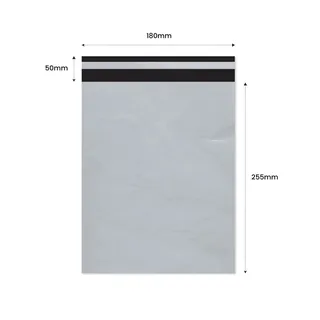
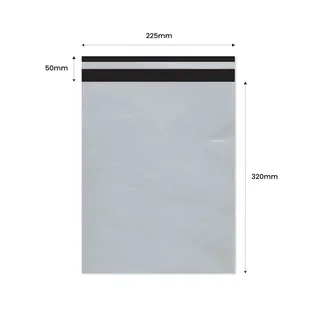
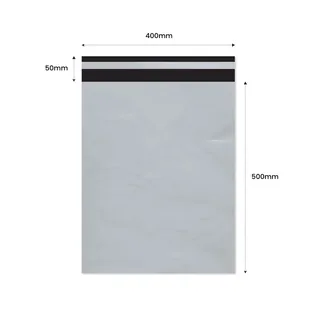
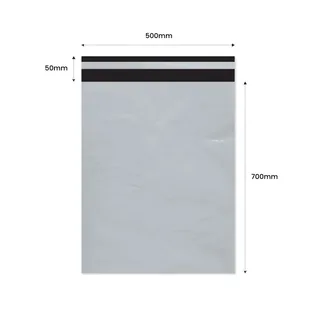
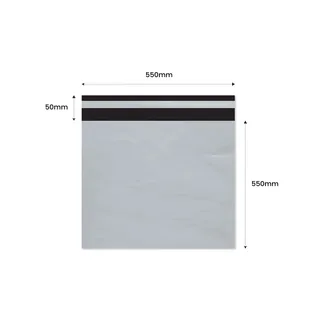
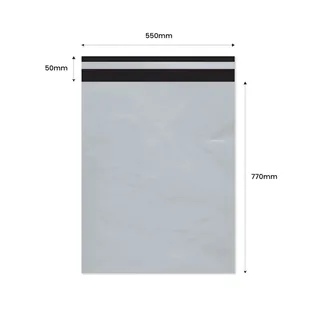
The size of an envelope is usually written as width × length + flap, for example 25 × 35 + 4 cm:
- the width is the side with the opening;
- the usable length is the distance from the bottom to the closing line, meaning the space the product goes into;
- the flap is the part with the adhesive strip that folds over the opening; it adds no space for the product.
Some manufacturers give the total length, including the flap. If the product page shows a single length value, check whether it is the usable or the total length. In our shop, the usable size and the flap are stated separately.
How to work out the right size
A product has volume, and a filled envelope loses width and length as it bulges. A practical rule:
- envelope width ≥ product width + product thickness + 2 cm;
- usable length ≥ product length + product thickness + 2 cm.
Example: a T-shirt folded to 20 × 28 cm and 3 cm thick needs an envelope at least 25 cm wide with 33 cm of usable length. A 25 × 35 cm format fits; a smaller one would strain the adhesive strip.
A bigger envelope is not safer: the product slides around inside, empty corners catch on sorting belts, and couriers may charge by size, depending on your contract.
Indicative sizes and uses
| Indicative usable size (width × length) | Typical use |
|---|---|
| around 17 × 25 cm | small accessories, boxed jewellery, A5 documents, socks |
| around 25 × 35 cm | T-shirts, underwear, unfolded A4 documents, thin books |
| around 32 × 42 cm | blouses, shirts, folded trousers, several small items |
| around 40 × 50 cm | hoodies, light jackets, bed linen |
| above 45 × 55 cm | thick jackets, blankets, bulky textiles, multi-item orders |
The exact sizes available are shown in the shop. If you regularly ship the same product, measure it packed exactly as it leaves your warehouse and choose the size using the rule above.
Thickness
Film thickness is given in microns (µm). A thicker envelope resists puncturing, abrasion and handling in sorting centres better, but costs and weighs more. Choose according to:
- content: soft textiles can go in a thinner envelope; items with corners (boxes, books) need a thicker one;
- weight: the heavier the parcel, the greater the stress on the seams and the adhesive strip;
- route: parcels passing through several sorting centres or shipped internationally are handled more times.
The thickness of each envelope is stated on the product page.
Opacity: white-and-black co-extruded film
Most courier envelopes are made from co-extruded film, meaning several layers extruded at the same time and bonded together during manufacture. The common combination is:
- white outer layer: the shipping label sticks well and is easy to read, and the surface can be printed with a logo;
- black inner layer: it blocks light, so the contents cannot be seen through the envelope, even in strong light.
Opacity protects the recipient's privacy and reduces the risk of theft, since the product cannot be identified from outside.
Closure
- Permanent adhesive strip: once sealed, the envelope cannot be opened without tearing or deforming it, which makes any tampering visible.
- Double strip for returns: some envelopes have a second adhesive strip, so the customer can use the same envelope to send a return.
- Document pocket: a transparent pocket stuck on the outside, for the invoice or accompanying documents.
The closure type is stated on each product page.
Quantities
Courier envelopes are delivered in the packs they are counted and packed in at the factory. When you add a quantity to the cart that cannot be delivered, the shop shows the two nearest permitted quantities and you choose.
To estimate your consumption:
| Step | Example |
|---|---|
| parcels per day in that size | 30 |
| shipping days per month | 22 |
| monthly consumption | 30 × 22 = 660 |
| reserve for damaged envelopes or repacking (about 5%) | 660 × 1.05 ≈ 693 |
| quantity to order, in full packs | 700 |
For large volumes, the price per piece drops at the tiers shown on the product page. For envelopes with your own logo, see Custom packaging.
In short
- Measure the packed product and add its thickness plus 2 cm in each direction.
- Check that the length on the product page is the usable length, without the flap.
- Choose the thickness according to content, weight and route.
- For privacy, choose white-and-black co-extruded film.
- Order based on real consumption.