How to choose bin bags
Updated: 30.09.2026
The right bin bag is chosen on four criteria: the volume of the bin, the type of waste, the thickness and material, and the closure. This guide helps you read the specifications on the product page correctly.
Litres and real dimensions
The volume of a bag (for example 35 L, 60 L or 120 L) is a nominal volume: the amount the bag can hold while leaving room to close it. It is not the maximum geometric volume of the bag.
The dimensions on the product sheet are those of the bag lying flat: width × length, in centimetres. When you open the bag, the flat width becomes half of its circumference.
For a quick estimate you can use this approximate formula:
Volume (litres) ≈ width² × usable height ÷ 3.14, with dimensions in decimetres.
Example for a 60 × 80 cm bag (6 × 8 dm):
- geometric volume over the full height: 6² × 8 ÷ 3.14 ≈ 92 L;
- if you leave 18 cm free for tying, the usable height is 6.2 dm: 6² × 6.2 ÷ 3.14 ≈ 71 L.
This is why a bag marked "60 L" usually has a geometric volume noticeably larger than 60 L. The difference is the space needed to close it without straining the seal.
Two bags with the same nominal volume can have different flat dimensions: one wider and shorter, the other narrower and longer. Choose according to the shape of the bin: for a tall, narrow bin the length matters, for a wide bin the width matters.
How to check whether a bag fits your bin
- Measure the inside perimeter of the bin opening (for a rectangular opening: 2 × length + 2 × width; for a round one: 3.14 × diameter).
- Multiply the flat width of the bag by 2. If the result is at least equal to the perimeter, the bag can be folded over the rim.
- Measure the depth of the bin. The bag length must be greater than the depth, with an allowance for folding over (usually 10-20 cm).
If the bag does not cover the perimeter, it can still be used sitting inside the bin, but it will not stay fixed on the rim.
Volume and typical use
| Nominal volume | Typical container | Notes |
|---|---|---|
| 10-20 L | office bin, bathroom bin | light waste, a thin bag is enough |
| 30-35 L | small kitchen bin | the most common size in flats |
| 50-60 L | large kitchen bin, large pedal bin | for mixed waste, choose a thicker bag |
| 100-120 L | 120 L wheelie bin, yard bin | check the width against the bin perimeter |
| 150-240 L | 240 L wheelie bin | bulky waste, high thickness |
| above 240 L | containers and industrial use | choose from the product sheet and the container dimensions |
The exact dimensions of each bag are shown on the product page.
Thickness: what microns mean
Thickness is given in microns (µm): 1 µm = 0.001 mm. A 20 µm bag has a 0.02 mm wall. The stated thickness is usually the thickness of a single wall.
Thickness alone does not tell the whole story. Two bags of the same thickness but different materials behave differently. Compare thickness only between bags of the same material, and use it together with the type of waste:
| Type of waste | What matters |
|---|---|
| paper, light packaging | low thickness, any material |
| mixed, wet household waste | a tight bottom seal and medium thickness |
| waste with sharp edges (glass, cans, building debris) | puncture resistance: LDPE or rLDPE, high thickness |
| leaves, grass, high volume | large volume and tear resistance |
Materials: LDPE, HDPE, MDPE, rLDPE
| Material | What it is | Typical behaviour |
|---|---|---|
| HDPE | high-density polyethylene | stiff, "crinkly" bag, strong in tension at low thickness; once punctured, it tears more easily |
| LDPE | low-density polyethylene | soft, elastic bag that stretches before it breaks, good for waste with sharp edges |
| MDPE | medium-density polyethylene | behaviour between HDPE and LDPE |
| rLDPE | recycled LDPE | properties close to LDPE; colour and appearance can vary between batches, which is why these bags are often dark |
The material of each product is stated on the product page. For products in the NU SUNT PLASTIC range, compostability according to EN 13432 is stated explicitly where it applies.
Closure: plain, drawstring or tie handles
- Plain bag: tied with a knot. The most economical option.
- Drawstring bag: a string runs through the hem of the opening; it pulls closed and ties easily, and the string can also hold the bag on the bin rim.
- Tie-handle bag: the opening has two handles that are tied together; practical for carrying and quick closing.
For bags full of heavy waste, a drawstring makes closing easier but does not increase the load capacity; that depends on material and thickness.
Colours for separate collection
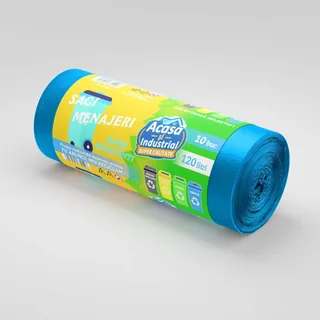
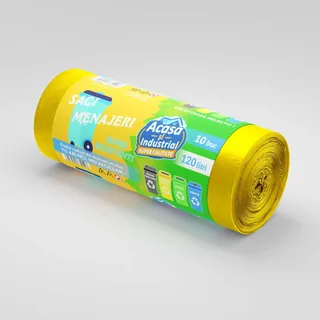
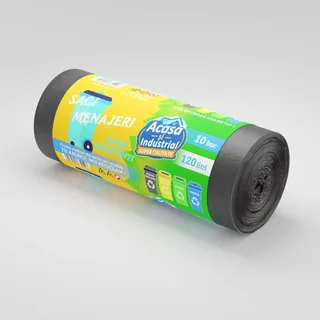
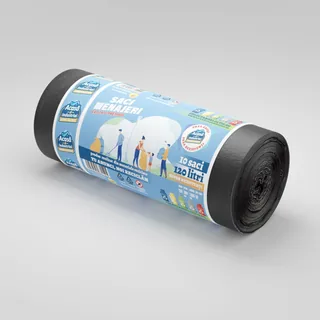
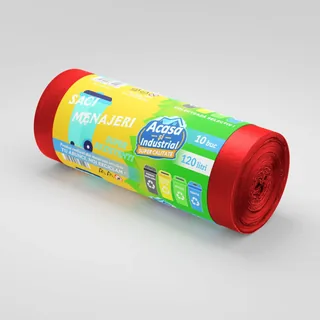
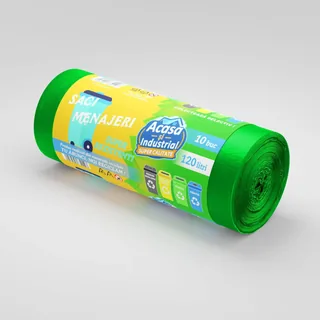
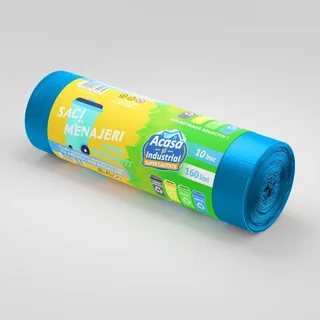
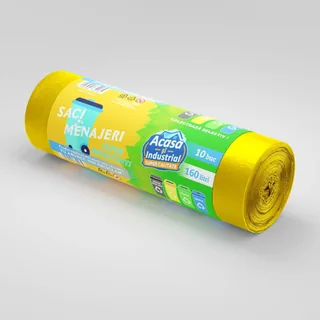
Many Romanian municipalities use the following colours for separate collection:
| Colour | Fraction usually collected |
|---|---|
| yellow | plastic and metal |
| blue | paper and cardboard |
| green | glass |
| brown | biowaste |
| black or grey | residual waste |
The exact rules are set by the waste collection operator in your area, and they differ between countries. Check them before buying, especially for biowaste, where some operators accept only compostable bags or require collection without a bag.
In short
- Choose the volume according to the container, then check the flat dimensions against its perimeter and depth.
- Choose the material and thickness according to the type of waste.
- Choose the closure according to how you use the bag.
- Choose the colour according to your local operator's rules.
If you need a size that is not in the shop, the factory can produce bags in the dimensions and thickness you require. See Custom packaging or write to [email protected].