Construction film calculator in square metres
Updated: 30.09.2026
Polyethylene construction film is used as a moisture barrier under floors, to protect materials and furniture, as temporary cover or, in its UV-stabilised version, for polytunnels. To buy the right amount, calculate the area in square metres and add the installation losses.
Area of a roll
Area (m²) = unfolded width (m) × roll length (m)
Example: a roll 4 m wide and 25 m long has 4 × 25 = 100 m².
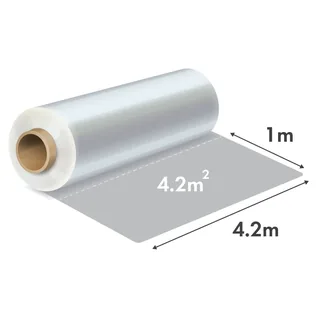
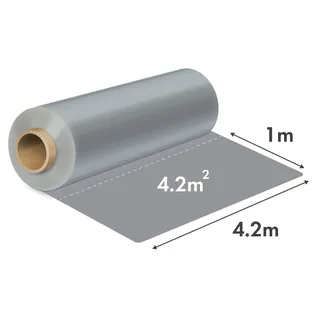
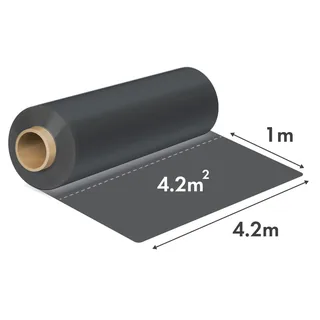
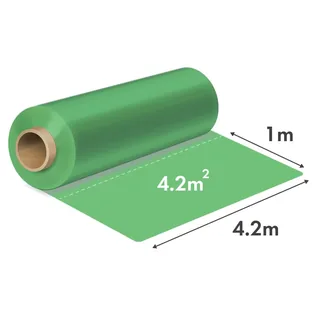
Watch out for the unfolded width. Wide film is often supplied folded so that it fits on a narrow roll. A roll measuring 1 m along the core may contain 4 m wide film, folded several times. Some films are supplied as a tube or half-tube (J-fold) that is cut and opened out. On the product page, check:
- the unfolded width (the usable width of the film);
- the roll length;
- the total area in m²;
- the folding method, where applicable.
Compare prices per m², at the same thickness.
Area to cover and losses
The net area (for example the floor area of a room) is not enough. Installation involves:
- overlaps between strips, usually 10 to 20 cm, or as required by the design or the system manufacturer;
- upturns on walls or folds at the edges, when the film has to run up the wall;
- cuts around posts, pipes and corners;
- offcuts at the ends of strips, because the roll width rarely matches the area exactly.
As a practical rule, for simple rectangular areas add 10-15% to the net area. For areas with many corners or obstacles, calculate strip by strip, as in the example below.
Example: barrier under a 7 × 10 m floor
Data: a 7 × 10 m room, film 4 m unfolded width, 25 m roll, 15 cm overlap, 15 cm upturn on each wall.
| Step | Calculation | Result |
|---|---|---|
| Dimensions including upturns | (7 + 2 × 0.15) × (10 + 2 × 0.15) | 7.3 × 10.3 m |
| 4 m strips laid along the 10.3 m length | 2 strips cover 4 + 4 − 0.15 = 7.85 m | enough for 7.3 m |
| Length of film used | 2 × 10.3 m | 20.6 m |
| Area of film used | 20.6 × 4 | 82.4 m² |
| Net floor area | 7 × 10 | 70 m² |
| Loss relative to net area | (82.4 − 70) ÷ 70 | about 18% |
One 4 × 25 m roll (100 m²) is enough, and the remaining 4.4 m of roll is left for repairs or other jobs.
Thickness
Thickness is given in microns (µm). Thicker film resists foot traffic, puncturing and tearing better, but costs more and is heavier.
| Use | Guidance |
|---|---|
| temporary protection when painting, covering furniture | thin film |
| covering materials on site, protection from dust and rain | medium thickness |
| moisture barrier under screed or flooring | the thickness required by the design or by the flooring system manufacturer |
For work with a technical design, follow the thickness and film type specified in the design.
You can check the thickness of a roll by weighing it. Polyethylene has a density of about 0.92 g/cm³, so:
film weight (g) ≈ area (m²) × thickness (µm) × 0.92
Example: 100 m² at 200 µm weighs about 100 × 200 × 0.92 = 18,400 g, i.e. 18.4 kg of film, excluding the core. If a roll declared with the same area and thickness weighs noticeably less, its real thickness is probably lower.
LDPE or rLDPE
| LDPE (virgin material) | rLDPE (recycled material) | |
|---|---|---|
| Appearance | can be clear or evenly coloured | usually black or dark |
| Consistency | consistent properties between batches | properties and appearance may vary between batches |
| Typical uses | applications where clarity or consistency matters | protection, covering, applications where appearance does not matter |
| Price | higher | usually lower |
Film made from recycled material reuses plastic that would otherwise become waste. Where the design requires a specific material, check the product's technical data sheet.
UV film for polytunnels
Ordinary polyethylene degrades in sunlight: it becomes brittle and tears. Polytunnel film contains UV stabiliser additives that slow this degradation. The stated service life (usually expressed in seasons or months) is the one on each product's technical data sheet.
The actual service life can be shortened by:
- contact with a metal frame heated by the sun (a protective tape on the hoops helps);
- certain plant protection treatments, which can affect the UV additives;
- excessive tension or rubbing in the wind.
Calculation for a tunnel polytunnel
Data: a tunnel 6 m wide and 3 m high, with roughly semicircular hoops, 20 m long, with 40 cm buried on each side.
| Step | Calculation | Result |
|---|---|---|
| Hoop length | 3.14 × 3 m (radius) | about 9.4 m |
| Film width needed | 9.4 + 2 × 0.4 | about 10.2 m |
| Length needed | 20 m + 2 × 1 m for fixing at the ends | 22 m |
| Roof area | 10.2 × 22 | about 224 m² |
| Each end (semicircle) | 3.14 × 3² ÷ 2 | about 14.1 m², plus an allowance for fixing |
The safest method is to measure the actual hoop with a tape run over the frame, from ground to ground, and add the allowance for burying. Choose a film whose unfolded width is at least equal to the result, so the roof is made from a single piece.
In short
- Use the unfolded width, not the width of the folded roll.
- Calculate the net area, then add overlaps, upturns and offcuts (in practice 10-15% for simple areas).
- Choose the thickness according to the use or the design.
- For polytunnels, use only UV-stabilised film and measure the actual hoop.
- Compare prices per m², at the same thickness.